

Solaris AI - cooling as flexibility.
AI-powered cooling flexibility for solar-driven cities. Built for Dubai Electricity and Water Authority, Solaris AI helps operators shift cooling demand into solar-rich hours using demand forecasting, thermal storage dispatch, comfort-aware optimization, and real-time weather and solar signals.

In solar-heavy cities, the cleanest electricity is often available before the highest cooling pressure hits. Solaris turns that timing mismatch into an operating strategy.
Instead of treating cooling as a fixed demand curve, it treats district plants, towers, hotels, malls, campuses, and thermal storage as a flexible portfolio that can absorb solar and reduce peak-risk pressure without sacrificing comfort.
Solar-aware dispatch for cooling operators.
Forecasts cooling demand
Solaris models cooling load from Gulf-climate signals: temperature, humidity, solar radiation, and apparent-temperature pressure. Operators see demand risk before it becomes grid stress.
Dispatches thermal storage
The optimizer schedules thermal energy storage charging during solar-rich windows and releases that flexibility when peak-risk cooling hours arrive.
Keeps comfort inside the guardrails
Solaris is not a blunt load-shed tool. It shifts cooling demand while maintaining zone comfort above the safety threshold, making flexibility operationally usable.
Turns flexibility into credits
Shifted kWh becomes Cooling Flex Credits, with bonus treatment when load is moved into high-solar-alignment hours and MRV exports for reporting.
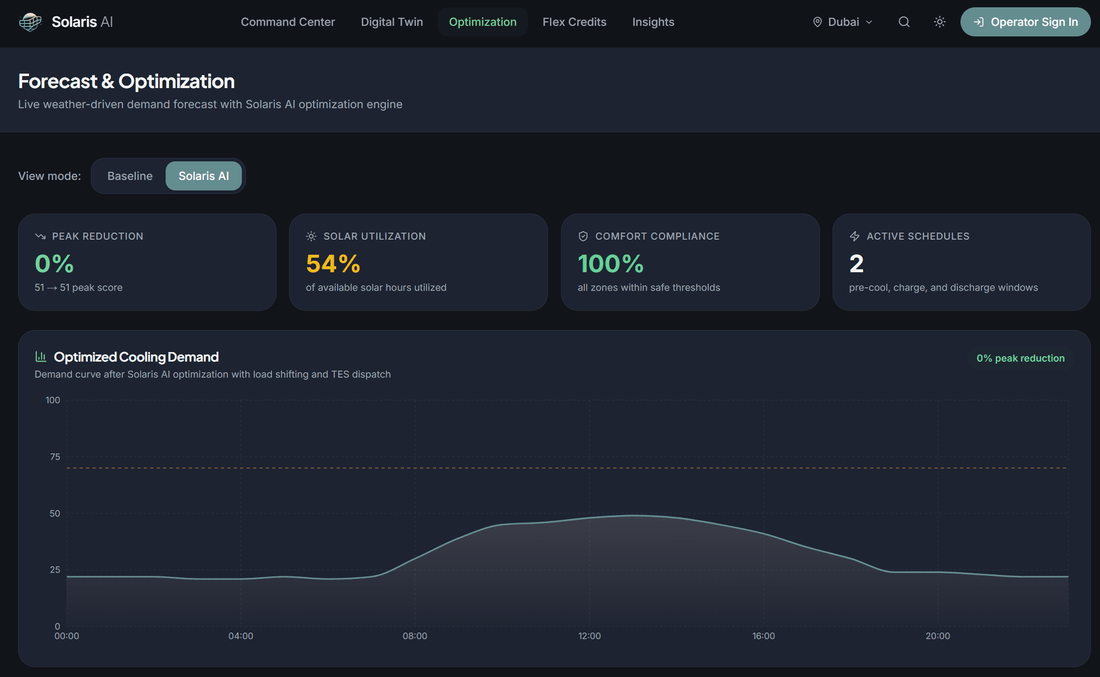
Demand curves become dispatch plans.
Solaris lets operators compare baseline demand against the AI plan, then read the outcome as peak reduction, solar utilization, comfort compliance, and active pre-cool or storage schedules. The result is a control-room view of cooling flexibility instead of another static energy dashboard.
From forecast to flex credit.
Solaris identifies solar-rich windows, schedules pre-cooling two hours before peak-risk periods, shifts up to 25% of peak demand into off-peak hours, and keeps comfort above the operational safety threshold.
- 01Ingest weather, solar, and cooling-asset state
- 02Forecast demand risk across plants, towers, hotels, malls, and campuses
- 03Schedule pre-cooling and TES charge or discharge windows
- 04Measure shifted kWh against the baseline curve
- 05Issue flex-credit and CO2 impact records for MRV export
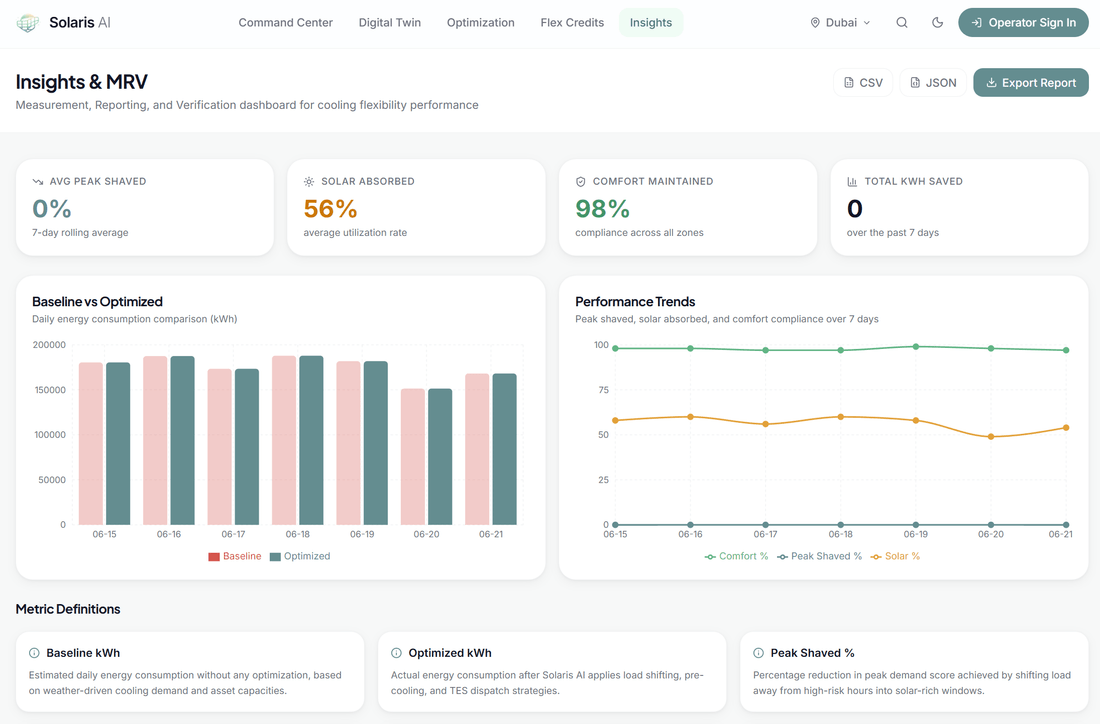
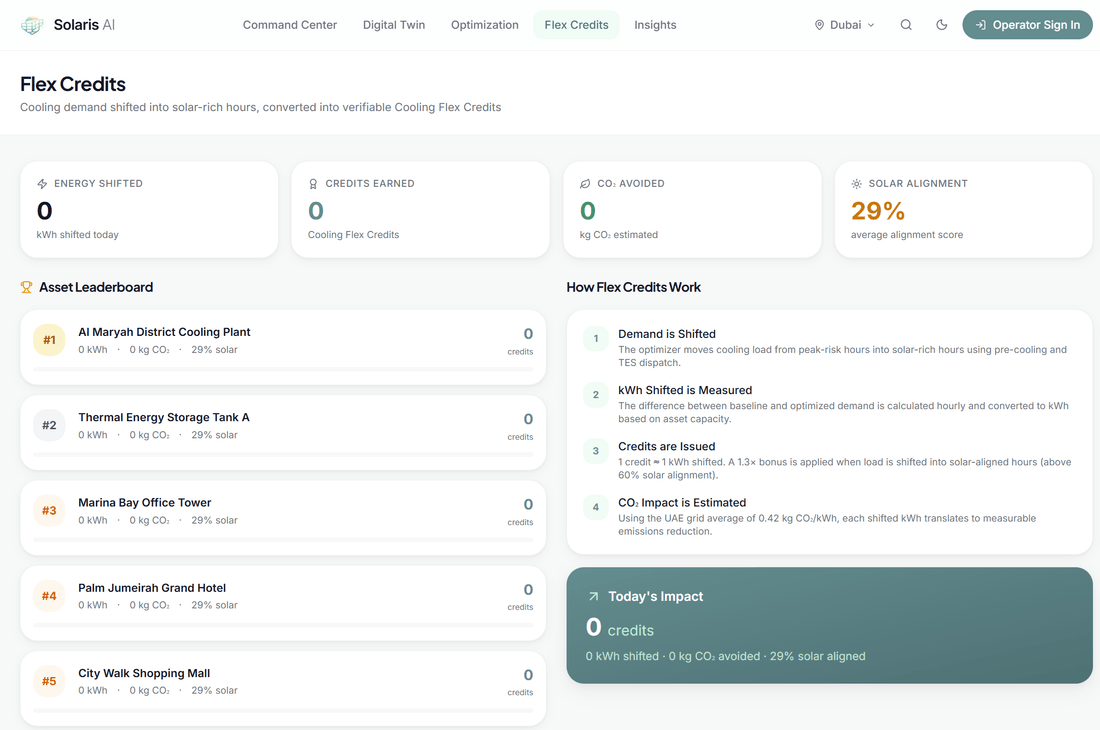
Cooling flexibility becomes accountable value.
The credit layer converts shifted cooling demand into measurable energy, emissions, and solar-alignment records. Operators can see which assets created flexibility, how credits were calculated, and where the day's impact came from.
The work behind Solaris AI
Cooling-flexibility forecasting for solar-driven cities: demand prediction, thermal-storage dispatch during solar-rich windows, and verifiable flex-credit reporting.
Services this build draws on
- Artificial IntelligenceFrom machine learning and natural language to computer vision and predictive analytics, we build a full suite of AI capabilities - tailored to how your business actually works, with a person reviewing the decisions that matter. No black boxes, no hype.Read the service page
- Dashboards & Internal ToolsYou can't run what you can't see. We build dashboards, admin panels, and internal tools that give your team a clear, real-time view of the numbers that matter - and the controls to act on them.Read the service page
