

EcoLens AI - verified circular economy.
A distributed edge-computing framework that turns ordinary waste bins into verified ESG data nodes. Built for American University of RAK, EcoLens AI combines on-device classification, cryptographic audit trails, impact quantification, and NRCC-ready reporting into one deployable circular-economy platform.

Most sustainability systems start after the mistake: a contaminated bag, a manual estimate, or a spreadsheet that asks everyone to trust the numbers. EcoLens moves intelligence to the disposal moment.
The result is a waste-intelligence node: low-cost hardware, real-time classification, cryptographic proof, and executive-grade circular-economy reporting from the same scan.
A full verification loop, not a bin camera.
Edge AI at the bin
A lightweight MobileNetV2 model runs through TensorFlow Lite at the point of disposal, classifying six waste streams without relying on a cloud round trip.
Tamper-proof evidence
Every disposal event becomes a SHA-256 audit record, linking classification, timestamp, and node identity into a chain that can be reviewed instead of merely trusted.
MRV-ready reporting
Impact is translated into carbon and resource-recovery metrics aligned with UAE Federal Decree-Law No. 11 (2024) and Cabinet Resolution No. 67 (2024).
Behaviour that compounds
Points, item journeys, tips, sustainability-library entries, and partner rewards turn waste segregation from a passive poster into a live feedback loop.
Four layers from scan to proof.
EcoLens separates perception, trust, action, and impact so the system can stay fast at the edge while producing compliance-grade records for institutions.
Perception
Camera input is classified locally with TFLite and MobileNetV2, keeping the disposal decision fast and independent from cloud latency.
Trust
Each scan becomes a disposal event with a SHA-256 hash, node identity, timestamp, and immutable audit-chain record.
Actuation
The user gets immediate feedback, bin guidance, rewards, learning prompts, and exportable CSV evidence from the same scan.
Impact
Resource value, CO2, REM, and NRCC readiness are calculated from verified ground-truth events instead of estimates.
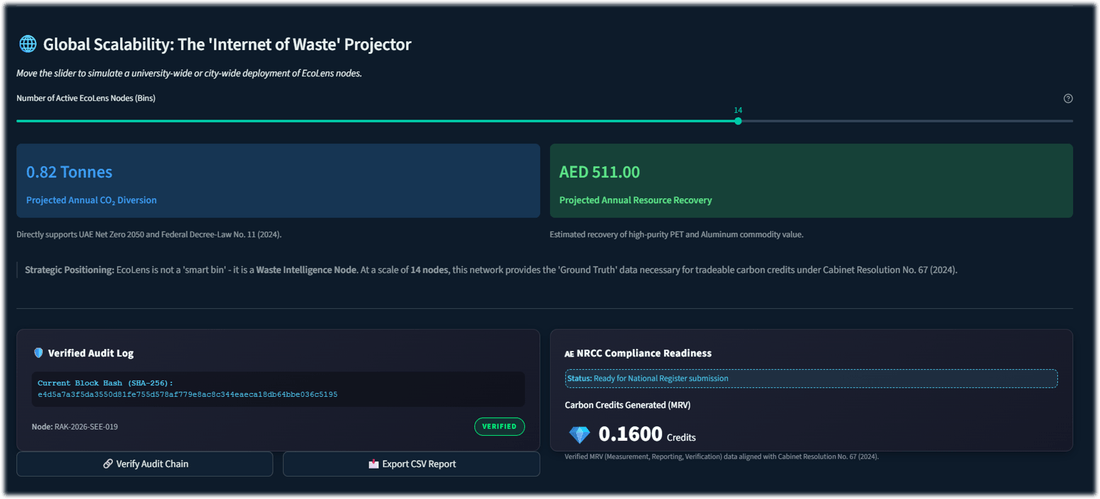
Real-world metrics, ready for scale.
The Phase 1 MVP was validated with live scan flows, item journeys, sustainability-library guidance, and one-click CSV exports. In the captured run, EcoLens measured AED 1,740 in leakage prevention, 19 phone charges of recovered energy equivalence, 0.76 car kilometers avoided, 16,000 LED hours, and 0.1600 verified credits.
That is the commercial promise: one campus can become the proving ground for a larger Internet of Waste network across universities, city facilities, and institutional ESG programs.
The work behind EcoLens AI
An edge-computing framework for verified circular economy - on-device waste classification, tamper-proof audit logs, and compliance-ready impact exports.
Built by Team Kanban, the studio's competition and experimental build team, at Hult Prize, university round 2026 - Winner of the university round. See the full competition record.
Services this build draws on
- Computer Vision & AI SurveillanceCameras already watch your sites - they just can't tell you what they see. We build computer vision systems that detect, monitor, and inspect from existing feeds, with people reviewing what matters so the system stays safe and accountable.Read the service page
- Artificial IntelligenceFrom machine learning and natural language to computer vision and predictive analytics, we build a full suite of AI capabilities - tailored to how your business actually works, with a person reviewing the decisions that matter. No black boxes, no hype.Read the service page
- AI Workflow AutomationWe design AI-assisted workflows that remove the manual, repetitive steps slowing your team down - with a human in the loop wherever judgement matters. Built around how your business already works, not a template.Read the service page
